Partial Solar Eclipse
The partial solar eclipse on August 12, 2026, took place under perfect weather conditions and provided the opportunity to take a few very special photos with surprising details of the finale.
Planning & Preparation
Astronomical events such as a solar eclipse can now be calculated to the minute many years in advance, so that people can plan and prepare for them well ahead. The big unknown, however, is – as always – the weather. I still remember some friends who had been looking forward to the total eclipse in southern Germany in 1999 – only to end up watching as the clouds grew darker. This time, however, it was clear days in advance that the weather would be perfect. The unusually dry summer showed itself at its best.
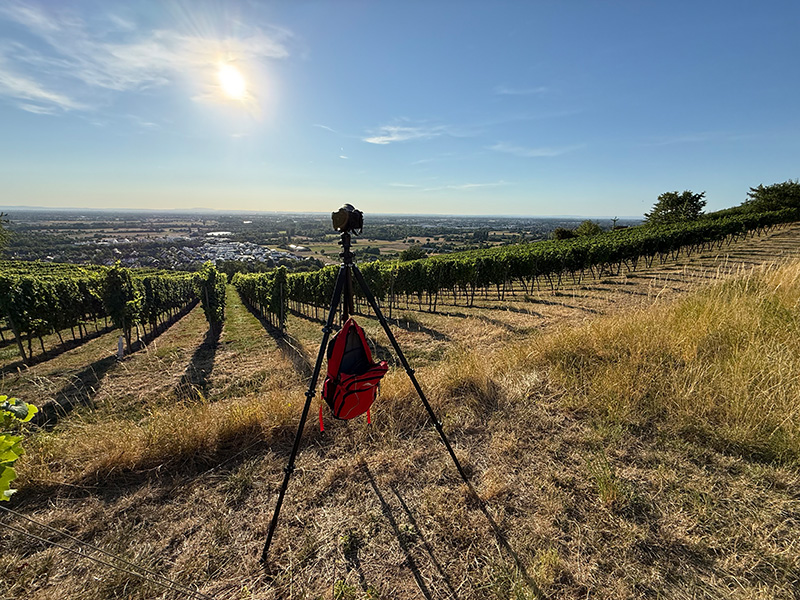
What was still missing, above all, was a suitable vantage point. Since the peak of the eclipse, with the Moon covering about 90% of the Sun, occurred about half an hour before sunset and thus relatively low on the horizon, I needed a spot with as unobstructed a view to the west as possible. Fortunately, the Bergstraße offers ideal conditions for this.
Above Heppenheim, there’s a wine trail that offers fantastic views of the Rhine Valley in many places. On a clear day, you can see far into the Palatinate Forest and the Hunsrück. The day before the solar eclipse, I explored the paths through the vineyards starting from Unter-Hambach and picked out the exact spot for the next day.
So the only thing left to decide was the equipment. It was clear that I would take both cameras with me: the R6 with the standard zoom lens for wide-angle shots of the scenery, and the R7 with the 100-400 mm telephoto lens for close-ups of the sun. And, of course, all the ND filters I had in my drawer, as well as a tripod and something to drink.
The Solar Eclipse at a glance…
I arrived on site about half an hour before it started and set up my equipment. The R6, equipped with the standard zoom lens and two combined ND filters, was mounted on a tripod and, using the internal timer, set to take a photo every minute. The camera was dialed in to an aperture of ƒ/8, ISO 100, and a shutter speed of 1/20 second, which – thanks to the ND filters—resulted in a (deliberately) significantly underexposed image even though I was looking directly at the sun. Apart from the sun, the image was almost completely black. But that was exactly the point: to be able to clearly make out the outline of the sun in the end.
The goal was to create a collage from the individual shots that showed all phases of the eclipse at a glance. To that end, I had also taken several photos that were exposed brightly enough to clearly show the landscape without the sun overwhelming everything. For the collage, however, the bright sun had to be removed from the image – and that wasn’t as easy as it sounded.
Most image-editing programs these days use AI. And no matter how I cropped out the section of sky in the middle, every AI tool ended up putting the sun back in where I’d removed it. So I had to resort to classic Photoshop techniques using the Clone Stamp and brushes. You can tell because the sky is patchy in places. But every attempt to compensate for this using “more modern” methods resulted directly in a sun being added back in again, even when the prompt explicitly said “no sun.” But at least this way, the result is “AI-free.”
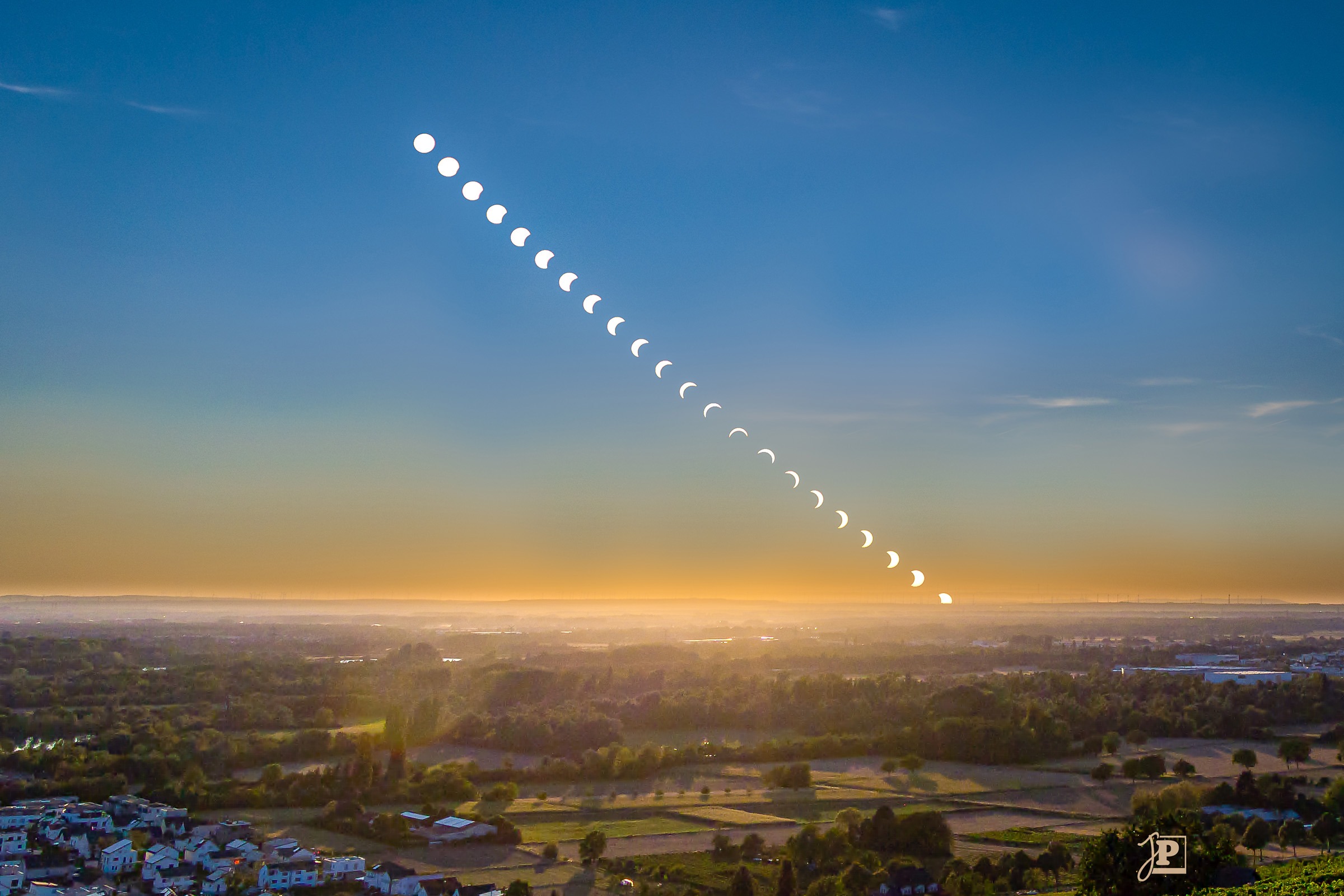
Once the base image had been fully edited, the remaining—and comparatively simple—step was to overlay the individual dark photos with the sun and combine them using the “Lighten” layer mode. In the end, I kept every fourth image, resulting in 22 sun disks that span the roughly one and a half hours from the start of the event until sunset. The result is not a “natural” image, since the brightness levels are unnatural – but that wasn’t the point here; the goal was simply to illustrate the process.
…and in Detail
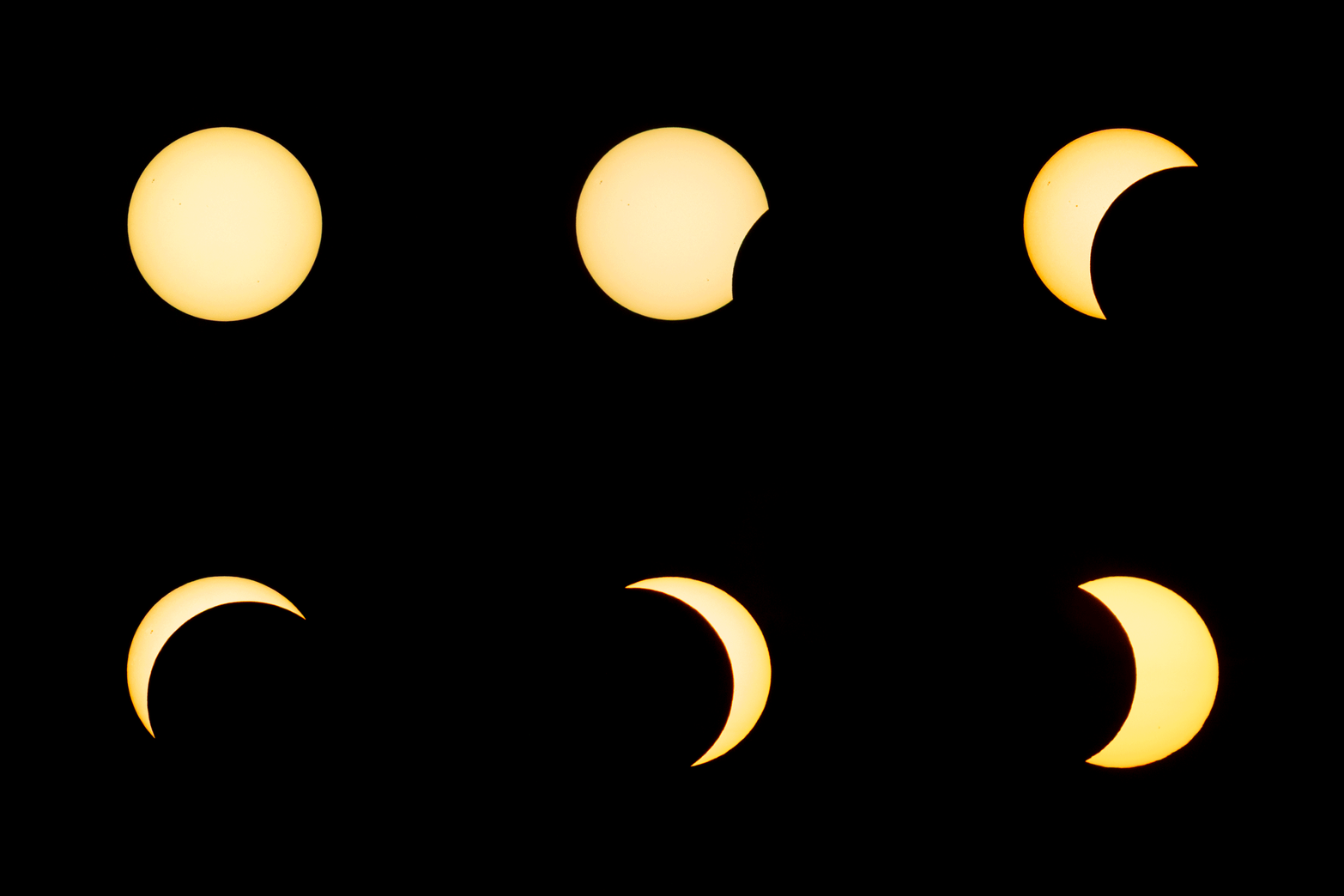
As the second camera, I brought along the R7 with the RF 100-400 mm telephoto lens to capture detailed shots of the sun. Here, I combined an 8x, a 64x, and a 1,000x ND filter to achieve a total of 512,000x, which put me well within the recommended exposure reduction range of 100,000 to one million to prevent damage to the camera. Even so, at the start, with an aperture of f/11 and ISO 100, the shutter speed was only 1/80 of a second, so I was able to shoot comfortably handheld. Using autofocus wasn’t a problem here either.
In the first test photos, I could already make out individual sunspots, which really encouraged me. I was all the more delighted when the first sliver of the moon came into view! From then on, I took more photos every few minutes. As the sky grew darker, I had to reduce the ND filters so that the exposure times would remain manageable.
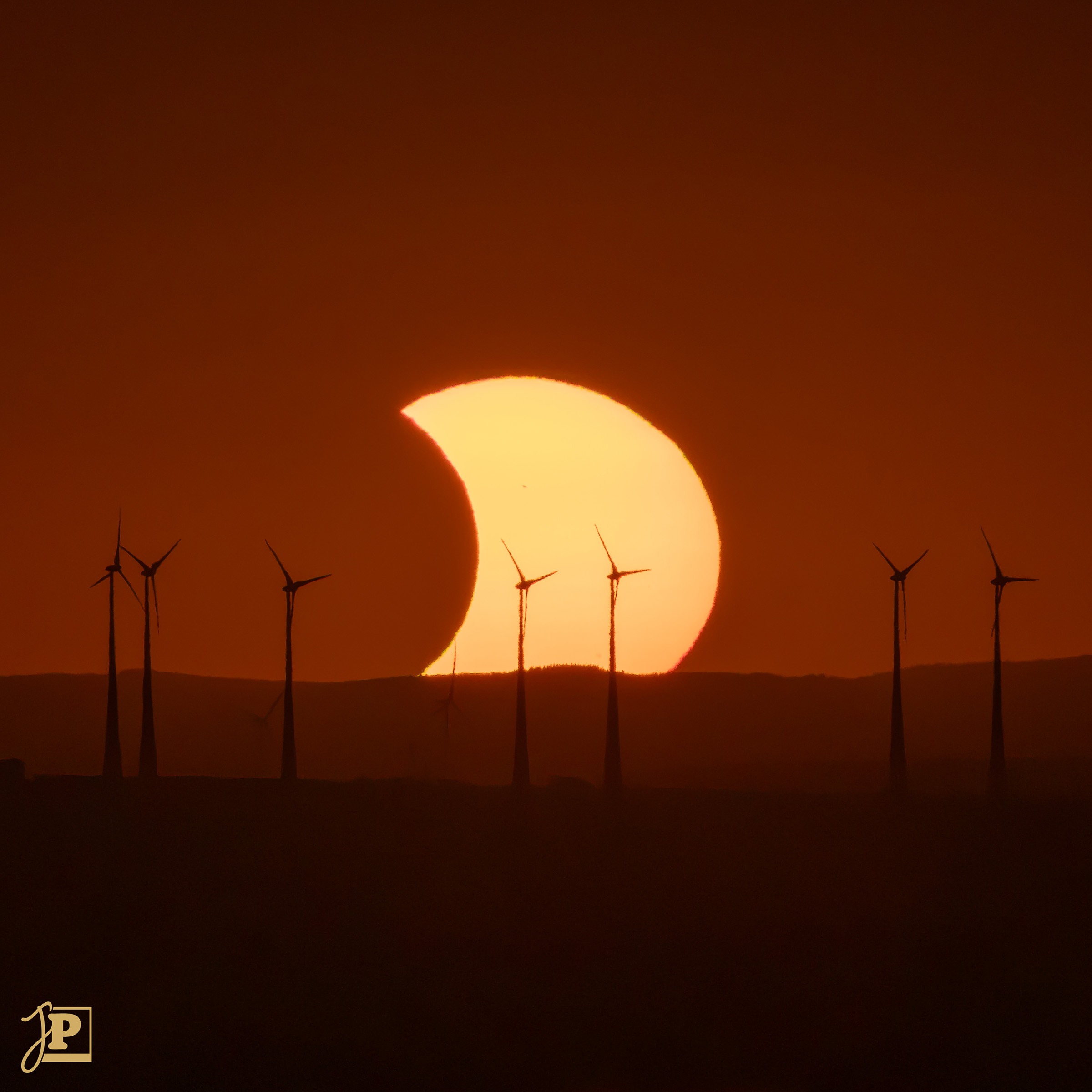
It was a very strange lighting mood when, around 8:15 p.m., the eclipse reached its maximum, with about 90% coverage. A strange twilight, completely different from any sunset. It was just as astonishing that it began to get lighter again as the sun set, which transitioned directly into the golden hour before the sun disappeared behind the horizon, still partially eclipsed.
The result of the second series of photographs is now a set of snapshots of the solar eclipse taken at various times:
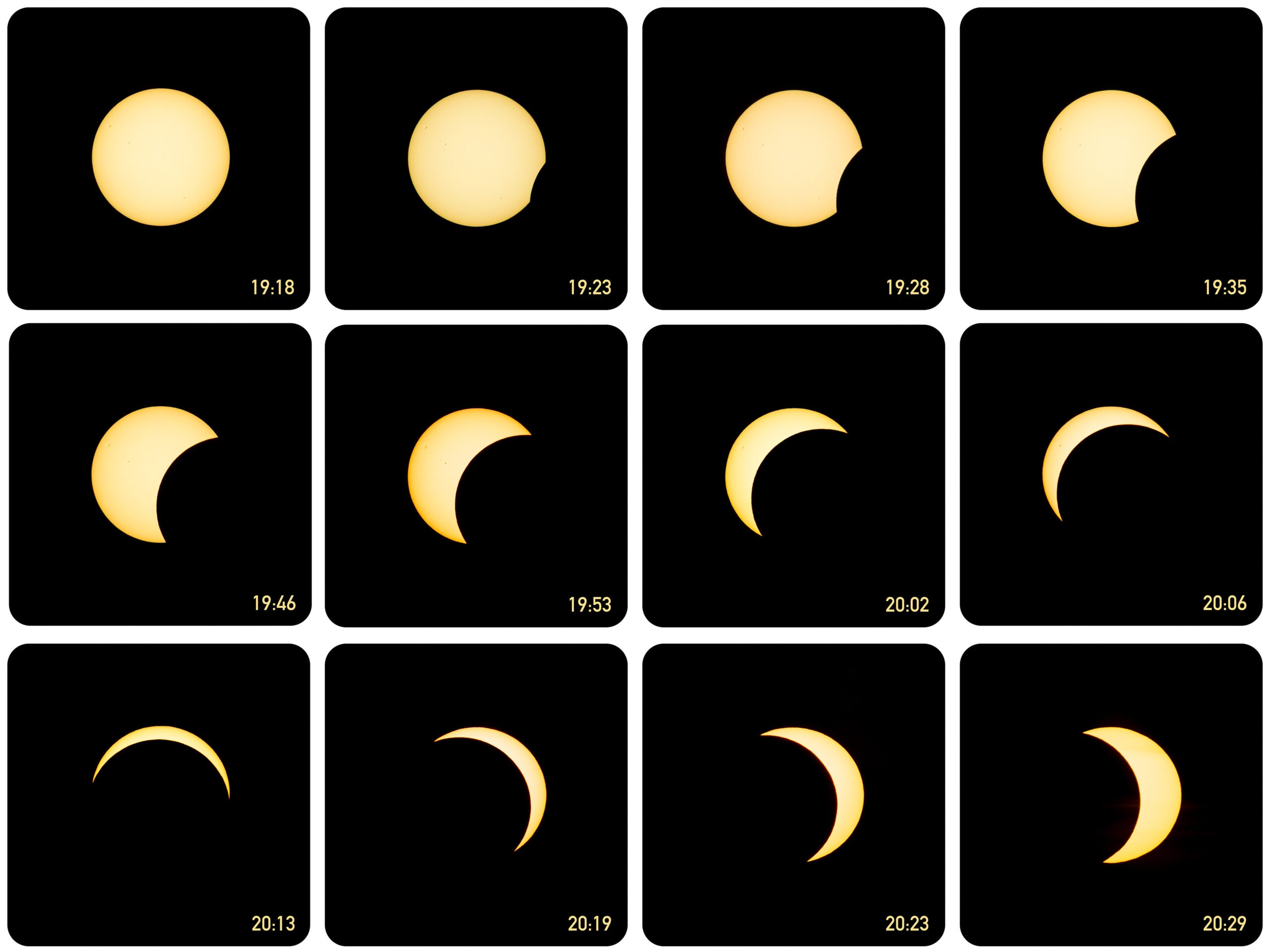
I then combined these into an animation in Photoshop:
Calendar Photos
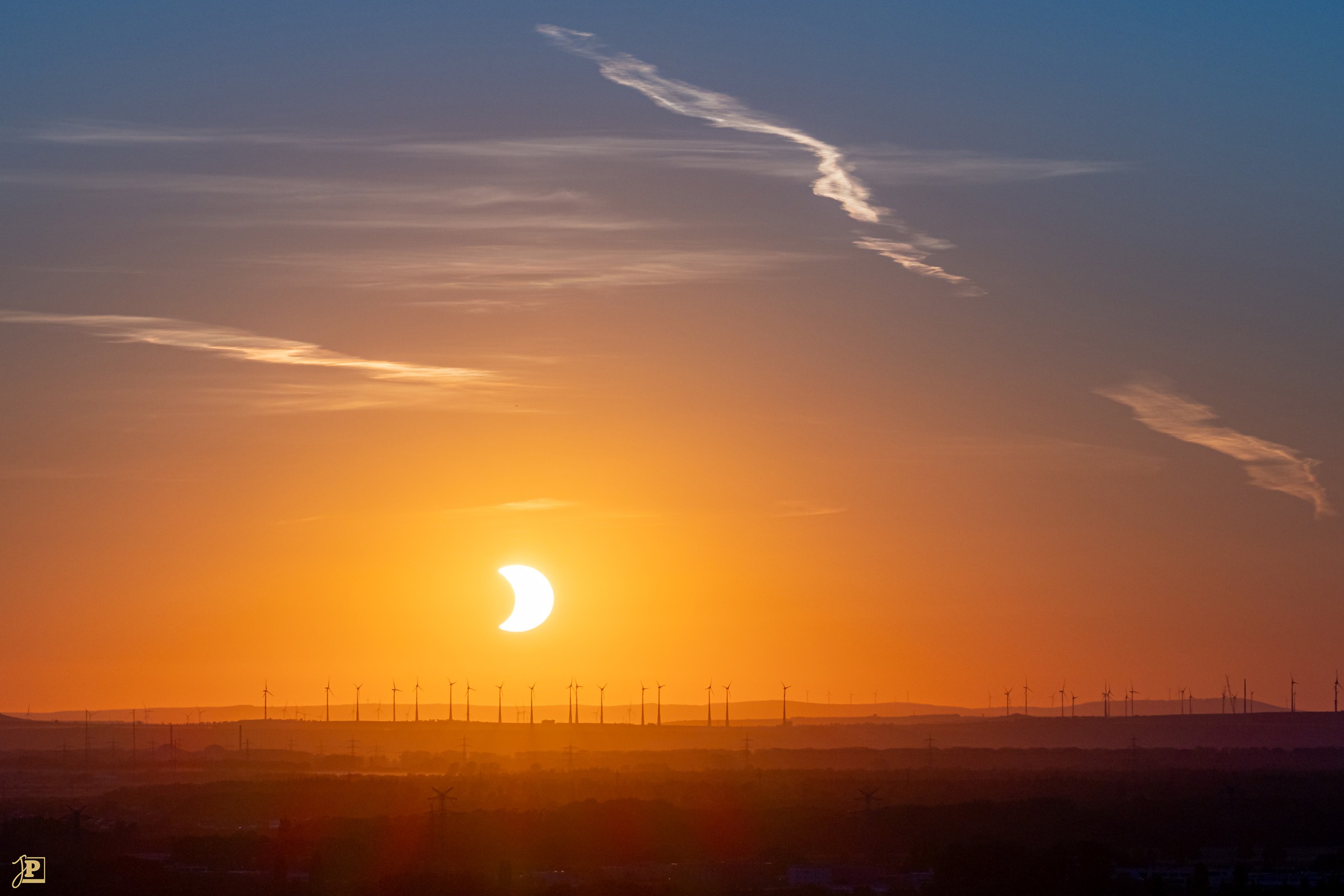
As mentioned earlier, the sun set while it was still partially obscured by the moon. This resulted in some very special sunset photos. The wind turbines in the Rhine Valley and the northern Hunsrück add unexpected details to the foreground.